
“ सेवा, सुरक्षा और समाधान ”
“ सेवा, सुरक्षा और समाधान ”
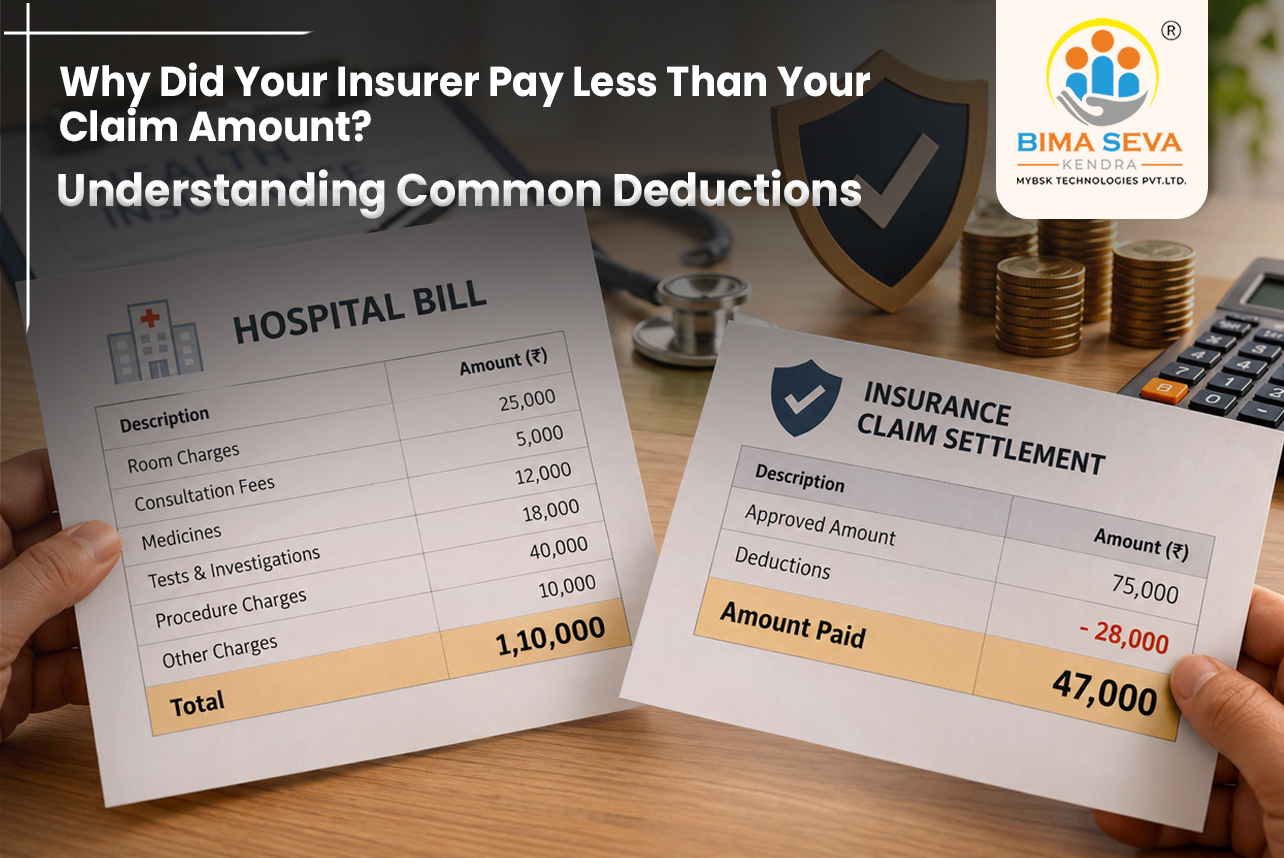
Why Did Your Insurer Pay Less Than Your Claim Amount Understanding Common Deductions
“Hello, I need some help understanding my insurance claim. The hospital bill was ₹2 lakh, but my insurer paid only ₹1.55 lakh. I thought my policy covered hospitalisation. Where did the remaining ₹45,000 go?”
Our team has heard this sentence a thousand times. Because with nearly ₹ 35 Cr+ worth of claims under consideration and 1500+ live cases, Bima Seva Kendra can confidently say this is a very common issue.
We understand why that would be worrying, especially after you have already dealt with a hospital bill. Let’s start with one important question: did the insurer send you a claim settlement statement explaining the deductions?
1. Gather Documents Before Distress
Policyholder: They sent a document, but it lists several deductions. I don’t understand half of them.
BSK Expert: That’s a good place to start. A lower payout does not automatically mean your claim has been rejected or that the insurer has made a mistake. The insurer may have applied conditions in your policy, excluded certain expenses, or calculated the payable amount differently from the total bill. We need to understand each deduction before deciding what to do next.
“What should I check first?”
These three documents:
- Your policy document, including the terms and conditions.
- The hospital’s final itemised bill.
- The insurer’s claim settlement statement or Customer Information Sheet (CIS)
If you made a reimbursement claim, keep the discharge summary, prescriptions, investigation reports and payment receipts handy as well.
Now compare the amount claimed, the amount the insurer considered admissible, each deduction and the final payment. If the statement only shows any suspicious or confusing deductions, ask the insurer for an itemised explanation.
2. What Is An Admissible Amount?
Policyholder: Isn’t the whole amount payable just because I have a policy?
BSK Expert: No. Your policy determines what is covered, subject to its terms and applicable regulations. But you are entitled to question a calculation you cannot understand.
“What are these deductions actually for?”
Policyholder: The statement mentions non-payable expenses, a sub-limit and co-payment. Can you explain those without the insurance jargon?
Absolutely. Let’s take them one at a time.
-
Non-payable expenses
Some items on a hospital bill may not be payable under your policy. Depending on the policy terms and applicable rules, these could include certain personal-use items or expenses that fall outside the coverage.
For example, if ₹5,000 of your bill relates to items that your policy does not cover, the insurer may deduct that amount. But don’t assume every item labelled “non-payable” is automatically correctly labelled. In case of any suspicious or double deductions, ask about the specific item, the amount deducted and the policy provision relied upon.
-
Sub-limits
A sub-limit is a cap on how much the insurer will pay for a particular treatment, condition, service or expense.
Suppose your policy has a ₹30,000 limit for a particular treatment expense, but the eligible expense is ₹40,000. The amount above the applicable limit may not be payable under that clause.
The exact effect depends on the wording of your policy. A sub-limit for one treatment does not necessarily mean the same limit applies to your entire hospital bill or treatment of other ailments.
C. Co-payment
A co-payment means you must bear a specified percentage of the admissible claim amount.
For example, if your policy requires a 10% co-payment on an admissible claim of ₹1 lakh, you would generally bear ₹10,000, and the insurer would pay ₹90,000, subject to the policy terms and any other applicable deductions.
D. Deductible
A deductible is an amount you must bear before the insurer becomes liable to pay under the relevant policy terms.
For example, if an applicable deductible is ₹10,000 on a claim of ₹1 lakh, the insurer’s liability is generally calculated after accounting for that deductible.
Co-payment and deductibles are different mechanisms. Check which one your policy actually contains, and whether other deductions apply too.
Policyholder: Wait. Can the insurer apply more than one of these to the same claim?
BSK Expert: Depending on your policy, yes. Several provisions may affect the final payout. That is precisely why you should request a calculation showing how each deduction was applied, rather than trying to work backwards from the amount deposited in your account.
-
“Could The Hospital Room I Chose Affect My Claim?”
Policyholder: I’ve heard that choosing a more expensive hospital room can reduce the amount an insurer pays. Is that true?
BSK Expert: It can, depending on the policy. Some policies have limits on room rent or ICU charges, thus triggering proportionate deductions when a room exceeds the eligible category.
For example, if your policy restricts room eligibility to a particular category, choosing a more expensive room could affect the claim settlement under the relevant clause.
Ask the insurer these questions:
- What room category was I eligible for?
- What room category was billed?
- Which policy clause applies?
- How was the deduction calculated?
- Did the calculation affect only the room charge or other hospital expenses too?
Don’t accept or reject a deduction based on a general rule you read online. Read your policy thoroughly.
-
“What If I Think The Deduction Is Wrong?”
Policyholder: Suppose I check everything and still cannot understand why the insurer deducted ₹20,000. What do I do now?
BSK Expert: Move from a phone conversation to a written request. That gives you a record of what you questioned and what the insurer explained.
Write to the insurer’s customer service or grievance redressal team. Include your policy number, claim number, date of settlement and the disputed amount. Attach the settlement statement and highlight the specific entries you want explained.
You can write something as simple as:
“Please provide an itemised explanation of the deductions applied to my claim, including the amount deducted under each head, the corresponding policy clause and the calculation used to arrive at the final payable amount. I request a review of any deduction that may have been applied incorrectly.”
Keep the acknowledgement and all replies. If you have additional documents that support your position, attach them and explain how they relate to the disputed deduction.
Policyholder: Should I refuse the settlement amount until they explain it?
BSK Expert: Don’t make that decision without understanding the consequences under your particular claim and policy. If the amount has already been paid, you can still raise a written dispute about the deductions. If the insurer asks you to accept a short settlement or sign a discharge document, read it carefully and seek clarification before agreeing to terms you do not understand.
-
“What if the insurer doesn’t resolve my complaint?”
Policyholder: And if the insurer simply repeats the same explanation—or doesn’t respond?
BSK Expert: First, escalate the complaint through the insurer’s formal grievance redressal mechanism and retain the complaint reference number. Explain what remains unresolved and include the earlier correspondence.
If you are still dissatisfied, you can consider the appropriate external grievance route. IRDAI provides a grievance redressal mechanism, and the Insurance Ombudsman can consider eligible complaints, including certain disputes involving partial claim rejection. Eligibility conditions and the applicable process matter, so check the current requirements before filing.
-
“Can Someone Help Me Make Sense Of All These Documents?”
Policyholder: I’m worried I’ll miss something in the policy wording. I don’t even know which deductions are worth challenging.
That is understandable. Insurance documents can be difficult to interpret when you are already dealing with a financial or medical setback.
This is where an independent review can help. Bima Seva Kendra (BSK) can help policyholders understand their policy and claim documents, examine the deductions and identify questions or potential discrepancies that may need to be raised with the insurer.
If a deduction appears inconsistent with the policy or the calculation cannot be justified, we challenge it through the formal grievance process.
Because a smaller payout deserves an explanation you can understand. Once you know what was deducted and why, you can decide what to accept, what to question and what to do next.
Conclusion
Going through a TLDR (Too Long; Didn't Read) phase? Here’s the summary:
- Claim settlement: Compare the amount claimed with the amount admitted and paid.
- Insurance claim-related issues: Check every deduction against the relevant policy clause and supporting calculation.
- Claim rejection services: If you need assistance, look for support that reviews the documents and explains your options without guaranteeing an outcome.
- Claim rejection: Do not confuse a fully rejected claim with a partial claim settlement/ short settlement.
- Claim rejection-related issues: If you dispute the decision, keep the evidence and raise a written complaint through the appropriate channels.
© 2026 MYBSK All Rights Reserved. Designed By SKALY INFOTECH PVT.LTD.